
Kraken Robotics: The Deep Dive
Kraken Robotics is a once-in-a-decade setup. Here's why:

Two hundred meters beneath the North Atlantic, it is pitch black and four degrees above freezing.
Something’s moving down there.
It’s shaped like a torpedo, gliding just off the seabed, sweeping the darkness with pulses of sound. It doesn’t breathe. It doesn’t sleep. But it’s seeing things no human has ever seen before, all to protect the most critical undersea infrastructure humanity has.
Four thousand kilometers east, in an operations room on the Baltic coast, a naval officer leans toward her screen. A tanker has just cut its transponder as it slows directly above a gas pipeline. She reaches for the phone.
And in Tokyo, in a tense SoftBank conference room, men in expensive suits are sweating through their shirts over a single question: where does a hundred billion dollars go when everyone wants physical AI and almost nobody's built it yet?
The oceans are being monetized. Naval warfare is going autonomous. The biggest capital wave in history is crashing out of software and into physical AI.
And at the intersection of all three sits exactly one publicly traded company — newly profitable, obscure, and headquartered on a windswept rock in Newfoundland.
It’s Kraken Robotics (TSX-V: PNG / OTC: KRKNF).
1. The Blue Economy
It’s telling that humankind has explored more of the Moon than the oceans.
Twelve people have walked on the Moon. Human eyes have seen less than 0.001% of the deep seafloor. According to NOAA, this means human eyes have seen an area of the entire seafloor equivalent to just one Rhode Island.
But it’s 2026, and the renaissance of the Blue Economy has begun. Not because humanity got curious, but because the ocean floor has become some of the most valuable real estate on Earth. Over 95% of international data traffic runs through subsea cables; offshore wind needs surveys before construction and inspection forever after; oil and gas runs thousands of aging wellheads and pipelines. The ocean floor is becoming needed infrastructure — and infrastructure must be seen to be managed.
That’s Kraken’s entire reason for existing. The company builds the eyes and the heart of the underwater economy: sonar that turns “there’s a thing down there” into “there’s a mine, half-buried, 400 yards away” — towed behind ships and uncrewed vessels via its KATFISH system, pressure-tolerant batteries, and the fuel tanks of the underwater drone age, all in such demand Kraken just opened a second plant. Add laser inspection services, and Kraken touches nearly every job on the seafloor.
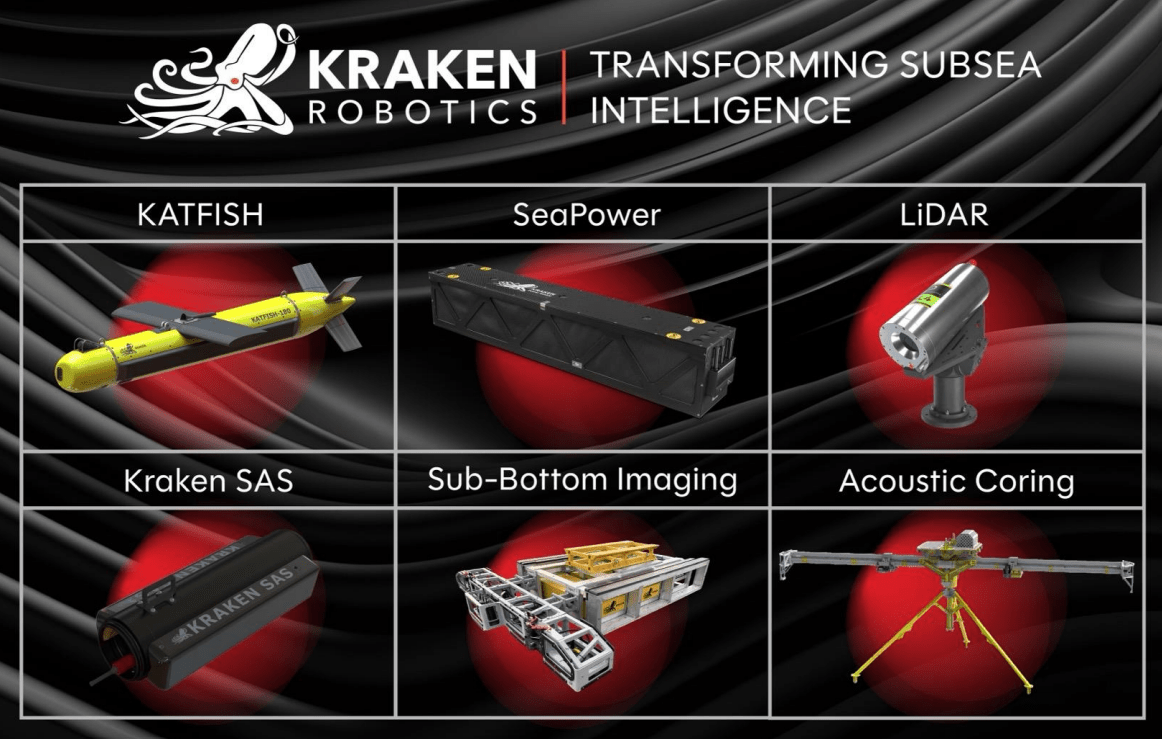
And demand here is structural, not cyclical: every underwater job is done either expensively (divers, crewed vessels) or efficiently (robots). Robots win every time, and every robot needs exactly what Kraken sells. It’s the picks and shovels of an entire domain going autonomous.
2. Defense
If there’s anything we’ve learned in the last five years, it’s that autonomous drones and robotics are the future of warfare.
Ukraine, a country of roughly thirty million, is embroiled in a stalemate with Russia, a nation of one hundred and forty-four million and a former superpower. This shouldn’t be possible. Conventional wisdom dictates that Russia should have overpowered Ukraine by now.
But no. Ukrainian long-range drones have struck Russian oil refineries nearly two hundred times in the first half of 2026 alone, knocking roughly a third of Russia’s refining capacity offline and forcing fuel rationing across most of the country. And the most lopsided domain of the war has gotten the least coverage: the water. Ukraine, a country without a functioning navy, forced Russia’s Black Sea Fleet away with uncrewed boats and missiles. Ukrainian robots costing six figures neutralized a fleet worth billions. Huh. It seems as though autonomous crafts just may be the future.
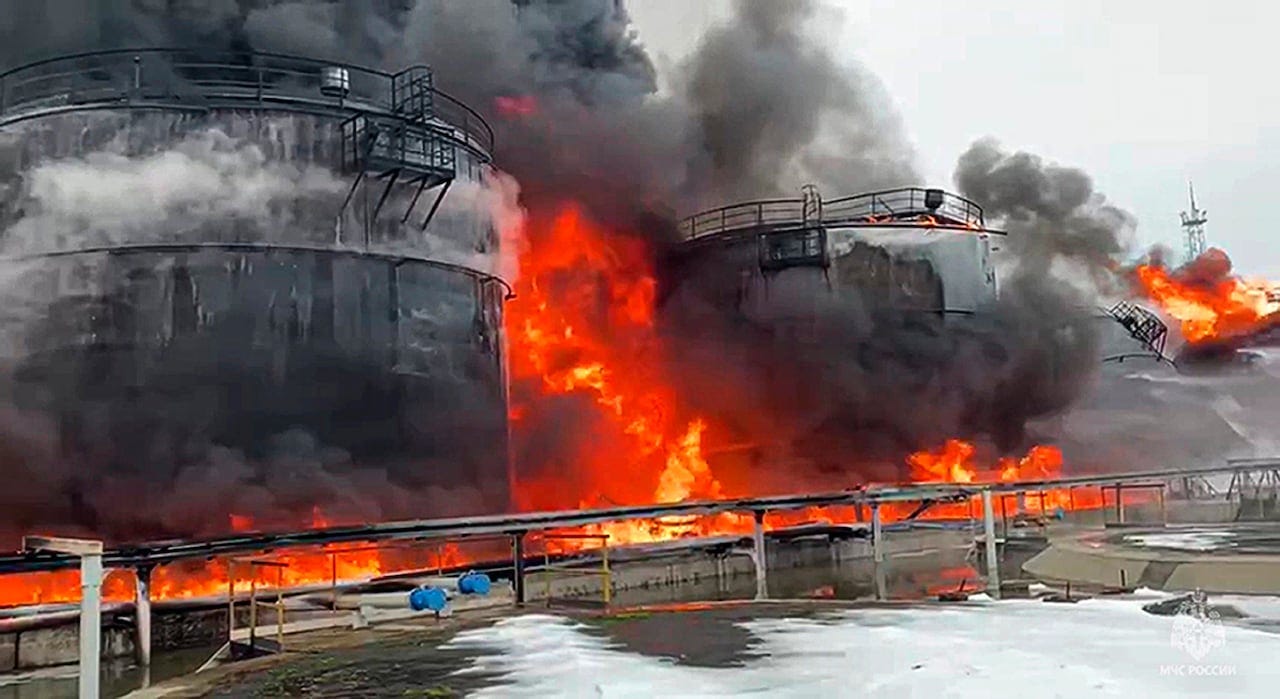
Western navies have all drawn the same conclusion: crucial infrastructure under active threat (the Nord Stream pipeline and the Baltic cables, as two examples) plus naval mines — the cheapest sea-denial weapon ever built — need autonomous underwater systems to defend them. This is Kraken’s exact niche. It builds neither the drone boat nor the submarine, but what makes them useful: sonar that’s the difference between a vehicle that swims and one that finds things, and batteries that decide whether a mission lasts hours or days. Kraken delivered the Royal Canadian Navy’s remote minehunting system, sells minehunting sonar across NATO, and keeps adding UUV (unmanned underwater vehicle) makers to its battery order book — whoever wins the underwater drone race, they all need power that survives at depth.
NATO is rearming. The undersea domain is the newest front. And Kraken is on the short list of companies navies can write a check to today.
3. Physical AI
Billions are flooding into physical AI, and as I argued in Where the Money Really Is in AI, it’s the least-developed, most opportunity-rich part of the AI buildout.
Sam Altman’s Startup Playbook puts it simply: it’s better to build something a small group loves than something a large group merely likes. Small and specific always beats vague and grand. The graveyard is full of dazzling technology in search of an application. Kraken inverted that — it started with the application (find the mine, map the seabed, inspect the pipeline) and then built the technology the application demanded.
And another key piece: underwater, autonomy isn’t a nice feature. It’s a must. There’s no GPS beneath the surface; radio dies within meters. Every AUV must perceive, navigate, and decide alone, in the dark, under pressure that would flatten a car. The ocean is the one domain where the robotics revolution isn’t optional. Kraken stands alone in filling a key void in the physical AI revolution.
Consider what that constraint actually demands. A humanoid robot in a warehouse can connect to a data center every few milliseconds; an AUV two hundred meters down cannot.
This is why the physical AI money flooding into humanoids and self-driving cars keeps hitting the same wall: the intelligence exists, but the sensors, the power systems, and the ruggedized hardware to embody it don't. Kraken has spent eighteen years building exactly those three things for the harshest environment on Earth.
When capital hunting physical AI exposure finally works its way down the water column, it will find that the stack has already been built.
4. The Commercial Leg
For all the drama above the surface, the steadiest part of Kraken’s business is the one it was built on.
Kraken was founded in 2008 in Newfoundland as a sonar company — Kraken Sonar, literally — and spent its first decade imaging the seabed for whoever needed to see it. That commercial DNA still anchors the business: service revenue grew 62% in 2025, to $40.5 million, on seabed surveys and inspections for energy clients. Recurring, needs-based revenue — infrastructure doesn’t stop corroding because the news cycle moves on. As long as the company exists, this will be a foundational part of the stream.
And here’s the key piece: the Covelya acquisition.
On July 2, only two weeks ago, Kraken closed the largest deal in its history: the $615 million acquisition of UK-based Covelya Group, parent of Sonardyne, the gold standard in underwater acoustic positioning and navigation since 1971. It matters because Covelya brings clients, years of expertise, and key engineers to create a juggernaut in the underwater robotics space.
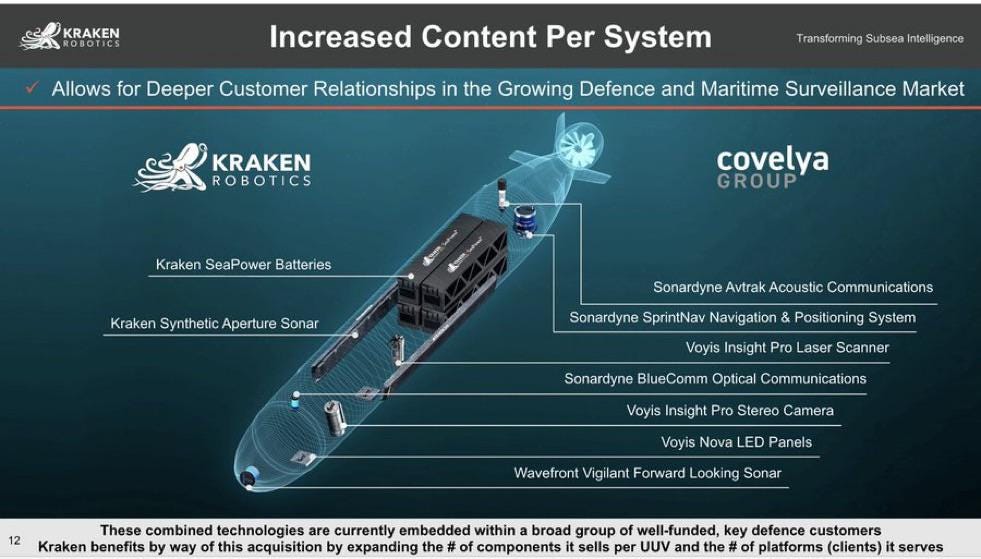
The structure tells you plenty. $480 million in cash, $135 million in shares. The combined company: 1,200 employees, 25 facilities, 110+ patents, and two clean business units: Defence and Commercial.
One deal took Kraken from niche player to the most complete pure-play subsea technology company in public markets.
5. Into The Books
A company at the intersection of three major tailwinds is fantastic. But it’s useless today if it’s cash-burning.
Just look at Rivian. Once a darling of the 2021 EV mania, it peaked at $179 that November, briefly becoming the world’s third-most-valuable automaker. Today it sits around $17, roughly 90% below that high, still unprofitable after twenty-plus billion dollars of cumulative losses and still passing the buck (a fresh $1.16 billion share sale just this month). It was perfectly positioned, and yet it faltered anyway. When the era of cheap money ended in 2022, “burn billions today for profits someday” became untenable and the stock crashed.
Kraken and Rivian diverge twice. First, the tailwinds: Rivian’s were transitive — political attitudes, tax credits, consumer sentiment — and politics change faster than anything else. Kraken’s are backed by decade-scale spending commitments, treaty obligations, and physics.
Secondly, Kraken is already profitable. It makes real money and has every year since 2023, funding its own growth. That removes the failure mode that kills growth companies: the forced march back to capital markets, raising on worse terms until shareholders drown in dilution. Kraken raises capital when it chooses to, not because payroll depends on it.
So, the books (all figures in Canadian dollars):
2025: Revenue of $102.2 million, up 12%. But gross margin jumped from 49.0% to 62.1%, meaning Kraken now keeps 62 cents of every sales dollar before overhead. Adjusted EBITDA came in at $25.0 million, a 24.4% margin. Net income was positive even after $5.0 million of one-time deal costs. Cash more than doubled to $120.5 million.
Q1 2026: revenue up 35%, product revenue up 50%, guidance reiterated.
Now, the growth:
2025 (actual): $102.2M revenue ($25.0M adjusted EBITDA)
2026, Kraken alone (guided): $165–175M revenue ($40–50M adjusted EBITDA)
2026, with Covelya from July 2 (guided): $290–320M revenue ($65–75M adjusted EBITDA)
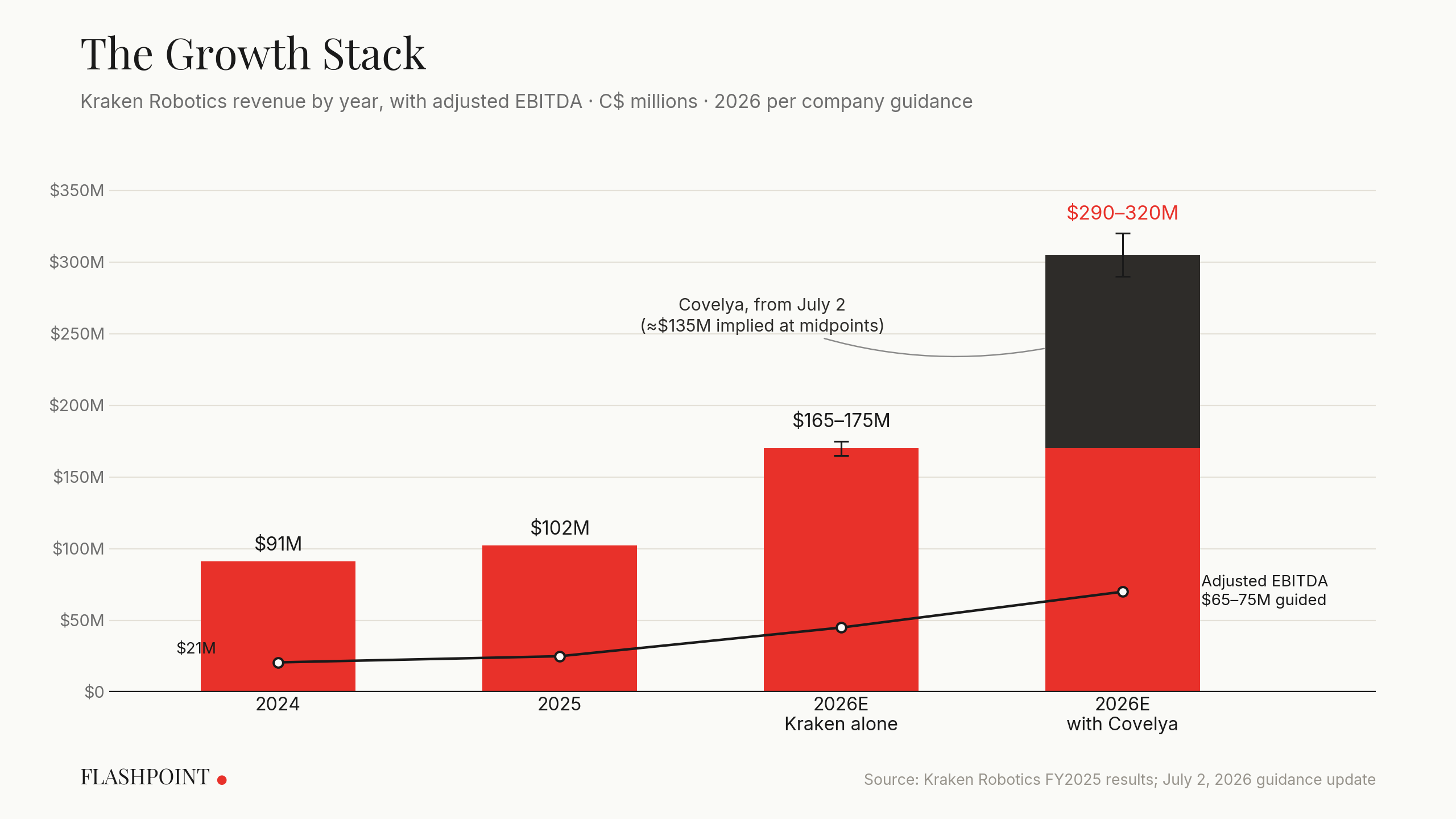
Kraken’s own business was guided to grow revenue 65%+ and operating profit 80%+ this year before Covelya contributed a dollar. And the third line includes only six months of Covelya, as the full combined engine did $365 million of 2025 revenue at a 24% EBITDA margin. Customers are voting with purchase orders, too: roughly $292 million of combined orders announced in 2026 to date.
The balance sheet took on weight to pull this off (a $402.5 million share sale at $8.50 plus a $125 million loan). The market is skeptical: at roughly US$4.74, the stock sits more than 40% below its 52-week high. Buyers today are paying 40x forward earnings — not cheap, but a number that shrinks quickly once a full Covelya year lands. Markets always do this after big acquisitions: they wait for proof.
Which is precisely where the risk and opportunity lives. You can’t wait to buy after it’s already been proven — the market will have already caught up, as it always does.
6. Some Ships Still Sink
No matter how seaworthy or indestructible a ship is, it could still find itself at the bottom of the ocean (hello, Titanic!).
Any deep dive must examine what could go wrong — though compared to some of my deep dives, the thesis here is fairly ironclad.
Integration risk. Covelya generated roughly two and a half times Kraken’s 2025 revenue, and Kraken is absorbing it across three continents while carrying $125 million of new debt. It’s a fish swallowing a whale! If cultures clash or key engineers walk, the accretion story becomes a miserable earnings call.
The main customer is a government. Defense revenue is slow. Delayed programs can make any quarter look ugly, and Kraken’s revenue is already guided mostly to the second half of 2026, leaving little room for error.
High expectations. The stock ran from under $2.50 to over $8 in a year before pulling back; much easy growth already happened, and buyers today are paying up-front for flawless execution. If 2027 comes in merely good, Kraken’s multiple has a long way to compress, and thin liquidity amplifies the way down.
Durable tailwinds and profitable operations don’t exempt a company from execution. They just mean execution is the only thing that can sink it.
7. Investing In Kraken
The future is being built while you read this. It doesn’t wait for you and me, nor does it wait for our brokerage accounts to catch up.
The oceans are being wired, mapped, and monetized for the first time in human history. Defense is undergoing its most profound transformation since the jet engine, and the newest front is underwater. Billions are flowing into physical AI, hunting for the rare companies that already have turned raw intelligence into real machines.
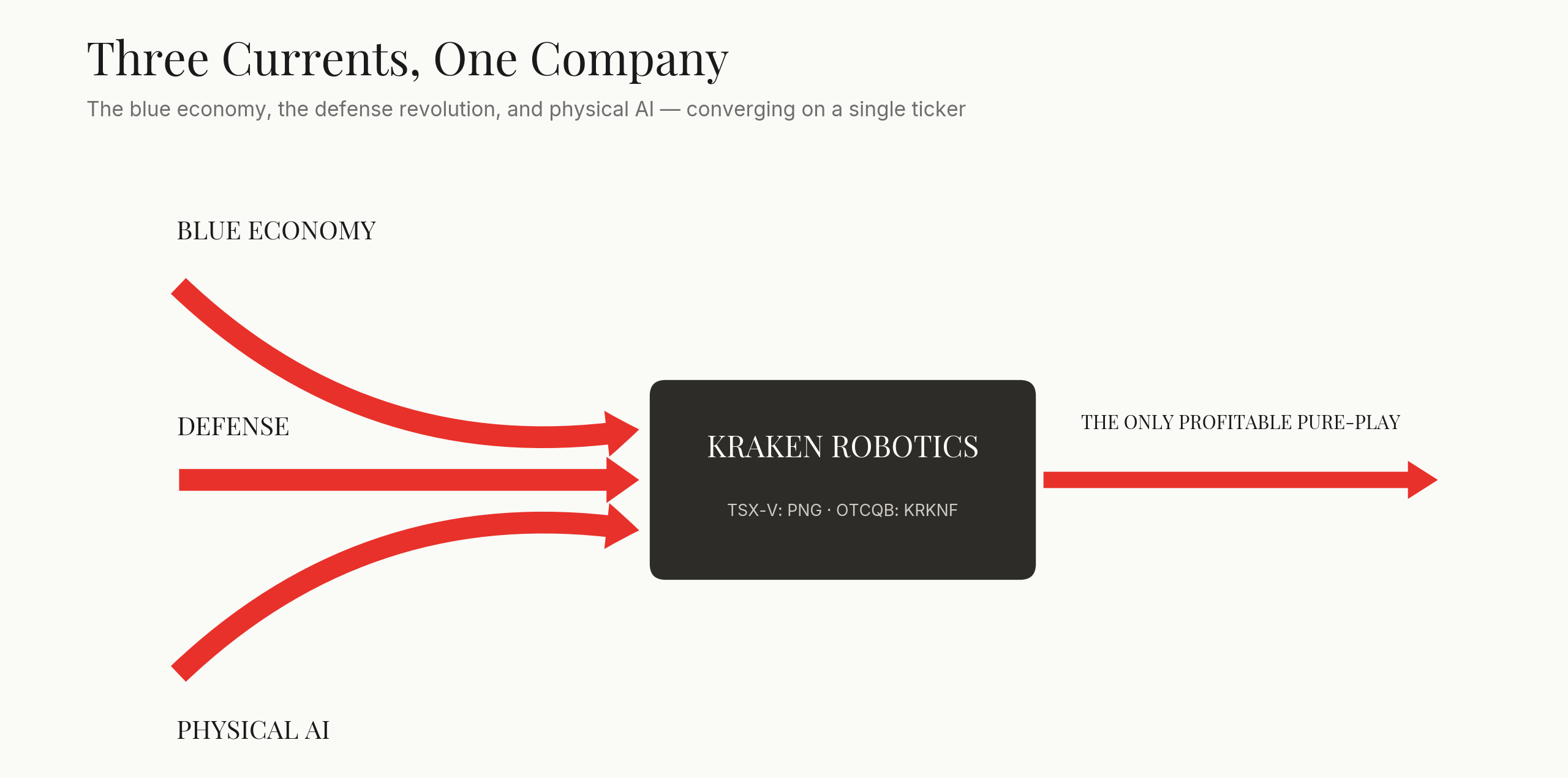
Three currents, converging on one point on the map: a company in Newfoundland that spent eighteen years learning to see, power, and navigate the deep — then, two weeks ago, bought the one company that completed its toolkit. Fully profitable. Growing 65%+ organically. Sitting on $292 million of fresh orders.
A picks-and-shovels play into the undersea defense revolution, physical AI buildout, and blue economy revolution.
Kraken Robotics.
16 July 2026 | Deacon Brantley | Not financial advice, please take care when investing and do your own research. Kraken Robotics ($KRKNF) is a holding in the Ignition Portfolio, initiated multiple times between $4.31 and $4.07.
If this is what the free Thursday piece looks like, consider what paid looks like: Monday macro deep dives, Saturday Ignition Portfolio updates with every trade and the reasoning behind it, and full access to the archives — all with 20% off.
Selected sources are below:
Kraken Robotics — “Kraken Announces $615M Covelya Acquisition” (March 3, 2026): krakenrobotics.com/news-releases/kraken-robotics-announces-signing-of-strategic-acquisition-to-expand-global-maritime-capabilities/
Kraken Robotics — “Closing of Strategic Acquisition of Covelya Group, Updated 2026 Guidance” (July 2, 2026): globenewswire.com/news-release/2026/07/02/3321394/
Kraken Robotics — “2025 Financial Results” (April 16, 2026): globenewswire.com/news-release/2026/04/16/3275147/
Kraken Robotics — “Q1 2026 Financial Results” (May 28, 2026): krakenrobotics.com/news-releases/kraken-robotics-reports-q1-2026-financial-results/
NOAA Ocean Exploration — “How much of the ocean has been explored?”: oceanexplorer.noaa.gov/ocean-fact/explored/
AP via ABC News — “Ukrainian drone attacks on oil refineries plunge Russia into a summer fuel crisis” (June 2026)
UNITED24 Media / Financial Times — “Ukraine Hit Russian Oil Refineries Nearly 200 Times in First Half of 2026” (June 2026)
Sam Altman — Startup Playbook
Yahoo Finance — RIVN & KRKNF quote data (as of July 14, 2026)