
REalloys: The Deep Dive
The only answer to decades of Chinese rare earth metallization dominance trades under a $1 billion market cap.

In a factory in southern China, a furnace runs at two thousand degrees.
Inside it, a remarkably boring grey powder is being turned into metal. The powder is called dysprosium oxide. It is worth more per pound than silver, and almost nobody outside that furnace in China can turn it into metal.
Meanwhile, an engineer at an American defense contractor is looking at a spreadsheet. One column lists the parts that go into the magnets for the weapons her company builds. The next column lists where those parts come from.
She counts how many trace back to that furnace.
Spoiler: all of them do.
And she has until January to fix that.
There’s one company in the entire Western hemisphere who can solve her problem.
Enter REalloys Inc. (NASDAQ: ALOY).

1. We Built the Oil Wells and Forgot the Refineries
Start with what a rare earth actually is, because the name is misleading.
Rare earths aren’t even that rare. The most common of the rare earths, cerium, is actually more common than copper in the Earth’s crust.
What’s rare is the ability to separate them from each other and turn them into something useful, because they’re chemically almost identical and cling together in the ground like sugar dissolved in water.
A better name would be “extremely useful and annoying earth metals.”
Two of them matter more than the rest for our purposes: dysprosium and terbium.
Here’s why. A magnet in a phone speaker just has to sit there. A magnet inside a missile fin, a jet engine, or a torpedo has to keep working while it gets extremely hot and undergo extreme pressures.
Ordinary magnets lose their magnetism when they heat up. Add a little dysprosium or terbium, and they don’t anymore.
So those two elements are the reason a heat-seeking missile can find its target instead of falling apart mid-air.
But turning rock into magnets takes four separate industries, stacked on top of each other:
All of them are difficult, dangerous, expensive, and unglamorous. And all of them are dominated by China.
Mining. Dig the ore out of the ground.
Separation. Split the seventeen elements apart from one another. Enormously difficult chemistry. This is the hard part.
Metallization. Convert the separated powder into actual metal you can work with.
Magnet making. Melt, mill, press, and bake the newly created metal into a finished magnet.
Think of it like oil.
Step one is the well.
Step four is gasoline in your tank or the natural gas in your stove.
Steps two and three are the refinery, and a country with oil wells but no refineries can’t do anything useful with the oil.
Your gas tank stays empty and your stove stays off.
That’s what’s happening in the West.
We lack the refineries — the metallization plants — required for turning rare earths into magnets, components, and applications.
For fifteen years, the West responded to China’s dominance by funding mines.
Mountain Pass in California. Mount Weld in Australia. Announcement after announcement, each one promising independence. Billions of dollars.
And the dependence got worse. Because China’s grip isn’t really on the mining. It’s on the refining.
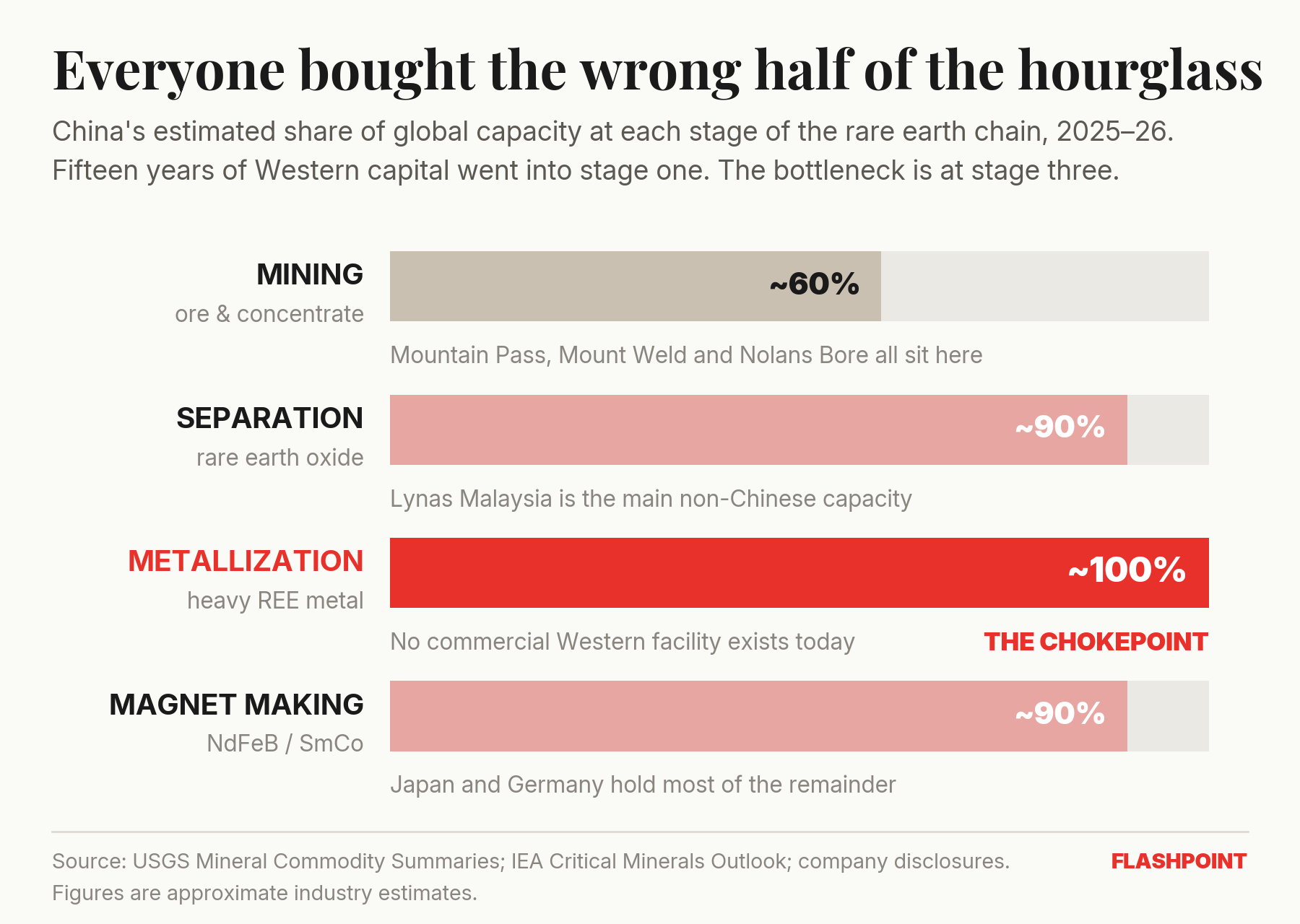
China controls roughly 60% of global mining. Meaningful, not fatal.
China controls essentially 100% of step three — turning heavy rare earth powder into metal.
Which means you can own the best, most productive rare earth mine on Earth and still be completely dependent on China, because your powder has to be shipped to that furnace before it can become anything at all.
Nobody in the West thought of building the refinery!
And there’s a reason for all of this. Mines are photogenic. They have results and press releases and pictures of trucks and other cool things. A chemical plant is ugly, hazardous, boring, and impossible to put on a slide.
The labor, permits, and capital required to create and operate a metallization plant is astronomical. And American companies, until now, have been unwilling to take the costs on.
So that’s where REalloys comes in.
Their newest facility in Euclid, Ohio is being built to produce about 30 tons of dysprosium metal and 15 tons of terbium metal a year, for roughly $40 million, with a target of being running by early-to-mid 2027.
Thirty tons is nothing next to a copper mine. But Western production of this metal today is basically zero. The comparison isn’t thirty tons against the world market. It’s thirty tons against nothing.
And $40 million isn’t a mining budget. It’s a mid-size factory budget. Which tells you something about where a small company chose to aim.
2. The Deadline
Most defense investments run on atmosphere. Budgets go up, the world gets scarier, someone eventually buys something.
This one has a date circled on a calendar.
There’s a new US government purchasing rule called DFARS 252.225-7052. It bans Chinese-made magnets from Department of Defense equipment.
It takes effect January 1, 2027.
On that date, a company building a guided missile, a sonar system, or an aircraft motor for the US military cannot use Chinese magnet material. There’s no loophole that makes it go away.
Now, picture yourself as a defense prime.
You aren’t shopping around and you aren’t negotiating. You aren’t asking about bulk discounts. If your production line stops because there’s no American-made dysprosium, you don’t care whether the metal costs $400 a pound or $900. The alternative is shutting down a program the Pentagon has already paid for.
That is about as good as a customer gets: legally required to buy, on a fixed deadline, with nowhere else to go.
You can charge whatever you want!
Which is why REalloys spent June starting the formal process of getting its material certified against that exact rule.
And that certification is a huge advantage.
Getting a new material approved for a weapons program takes years. Test protocols, program office sign-offs, engineering reviews, and a mountain of paperwork that a better-funded competitor showing up in 2028 cannot skip.
Whoever is approved on January 1, 2027 gets a head start that money can’t buy back.
3. The Army Gave Them Something Better Than Money
On June 25th, the US Army picked REalloys to negotiate exclusively for a long-term lease at the Tooele Army Depot in Utah — to design, pay for, build, and run a rare earth processing plant on an active military base.
The Army isn’t writing a cheque. It’s acting as a landlord. It provides the land; REalloys brings the money.
Try building a chemical plant on ordinary land in the United States. You’re looking at five to seven years of environmental reviews, county hearings, water rights and lawsuits — and that’s if nothing goes wrong.
Now build it inside the fence of a base that has been an industrial site since the Second World War. Easy!
REalloys is targeting construction as early as 2027 and operations by 2028.
On private land, those dates are fiction. On an Army base, they’re plausible.
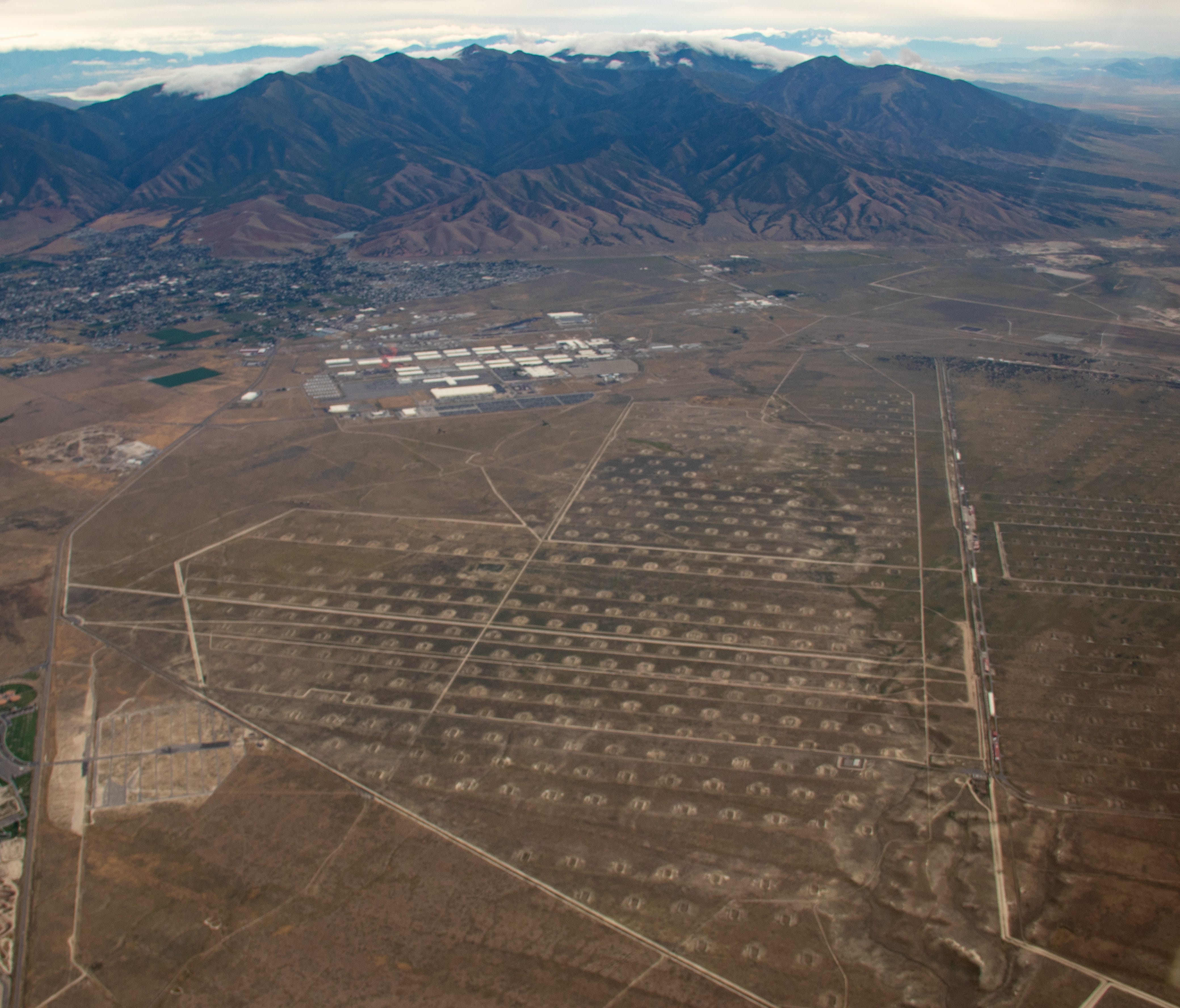
There’s a second signal hidden in the announcement. Four companies were selected under this program — the first time the Army has ever allowed commercial mineral processing on its installations. One was picked for the heavy rare earths.
The United States Army does not put a first-of-its-kind chemical plant next to munitions storage because someone gave a good presentation.
Your landlord and your customer being the same institution isn’t a contract. But it isn’t nothing.
The Army handed this company the hardest thing to get in American heavy industry. Permission to build and grow.
4. Handshakes
The company describes itself as “mine-to-magnet.” Let’s be precise about what that means, because the precision is the whole story.
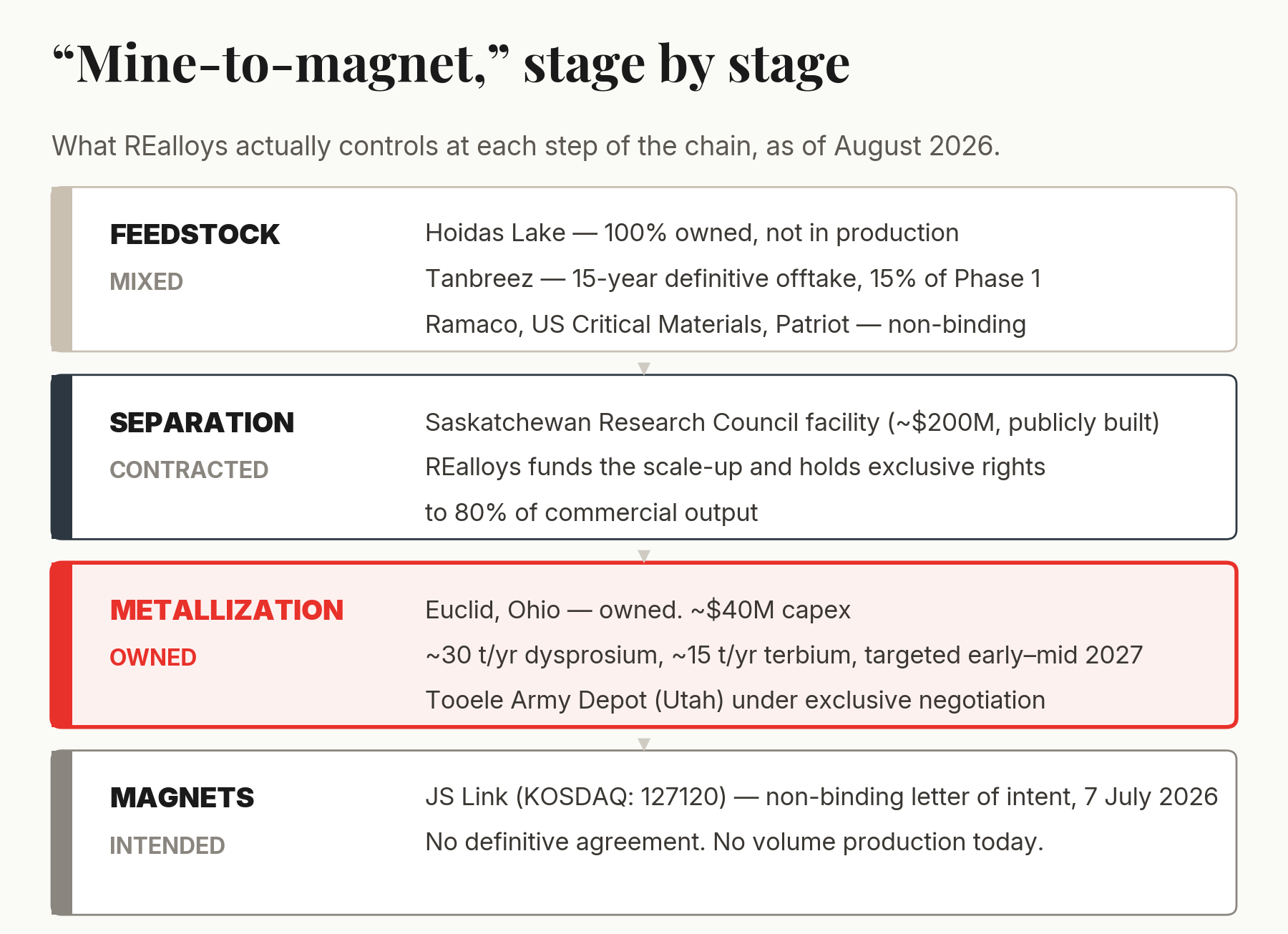
REalloys does not own a working mine. It owns a deposit in Saskatchewan called Hoidas Lake, but nothing is being dug there right now and nothing in the near-term plan depends on it.
REalloys does not own the plant that separates the elements. The Saskatchewan Research Council does — a facility built with about $200 million of Canadian public money. REalloys is paying to help expand it, and in exchange has locked up the rights to 80% of what comes out.
REalloys does not yet make finished magnets in any volume. In July it signed a letter of intent with JS Link, a South Korean magnet manufacturer, to explore doing that together.
So the honest description isn’t a company that owns the whole chain.
It’s a company that assembled one — out of other people’s assets, held together by contracts, exclusive rights, and in some cases nothing more than a written intention to keep talking.
And the argument for this being clever, rather than flimsy, is straightforward.
Owning the whole chain means paying for the whole chain. Building a separation plant from scratch costs half a billion dollars, takes five years, and has a real chance of never working. REalloys instead paid to speed up a plant somebody else had already built, and bought first claim on the output.
On raw material, it spread out rather than betting on one source: agreements across Greenland, Kazakhstan, Brazil and North America — including a signed fifteen-year deal for 15% of the first phase of production from Tanbreez in Greenland, one of the largest heavy rare earth deposits anywhere.
On magnets, it’s partnering with someone who already knows how, instead of learning.
For a company this small, the question that matters is how much of the chain you control per dollar spent. On that measure, renting beats owning by a mile.
As long as the other side actually delivers.
In summary:
REalloys sources rare earths from mining sites around the US and Canada. It separates them into each element, is going to turn the elements into the useful metals, and is planning to build magnets soon.
Envision a full-stack rare earth sourcing, separation & processing, metallization, and magnet fabricating company. That’s the vision of REalloys.
5. The Uncomfortable Part
A company sitting on top of three enormous trends is a wonderful thing. It’s also worthless if the finances can’t carry it there.
Ask Molycorp.
In 2010, China cut its rare earth exports and the West panicked. Molycorp owned Mountain Pass, the only rare earth mine in America. It went public that July at $14 a share. Within a year it hit $77. It raised more than a billion dollars.
Every argument in this article, Molycorp made first — and made louder.
It went bankrupt in 2015.
Not because the argument was wrong. The argument was right; China really did weaponise the supply chain, and still does. Molycorp died because it built the wells instead of the refinery, spent $1.5 billion doing it, and then needed to raise money again at the exact moment nobody wanted to give it any.
Two lessons. Build where the bottleneck actually is. And never be forced to raise money at the worst possible time.
REalloys gets the first one right. The second is genuinely unresolved.
So, the numbers. They are not pretty.
Last year (2025), the company made $2.4 million in revenue and lost $4.4 million.
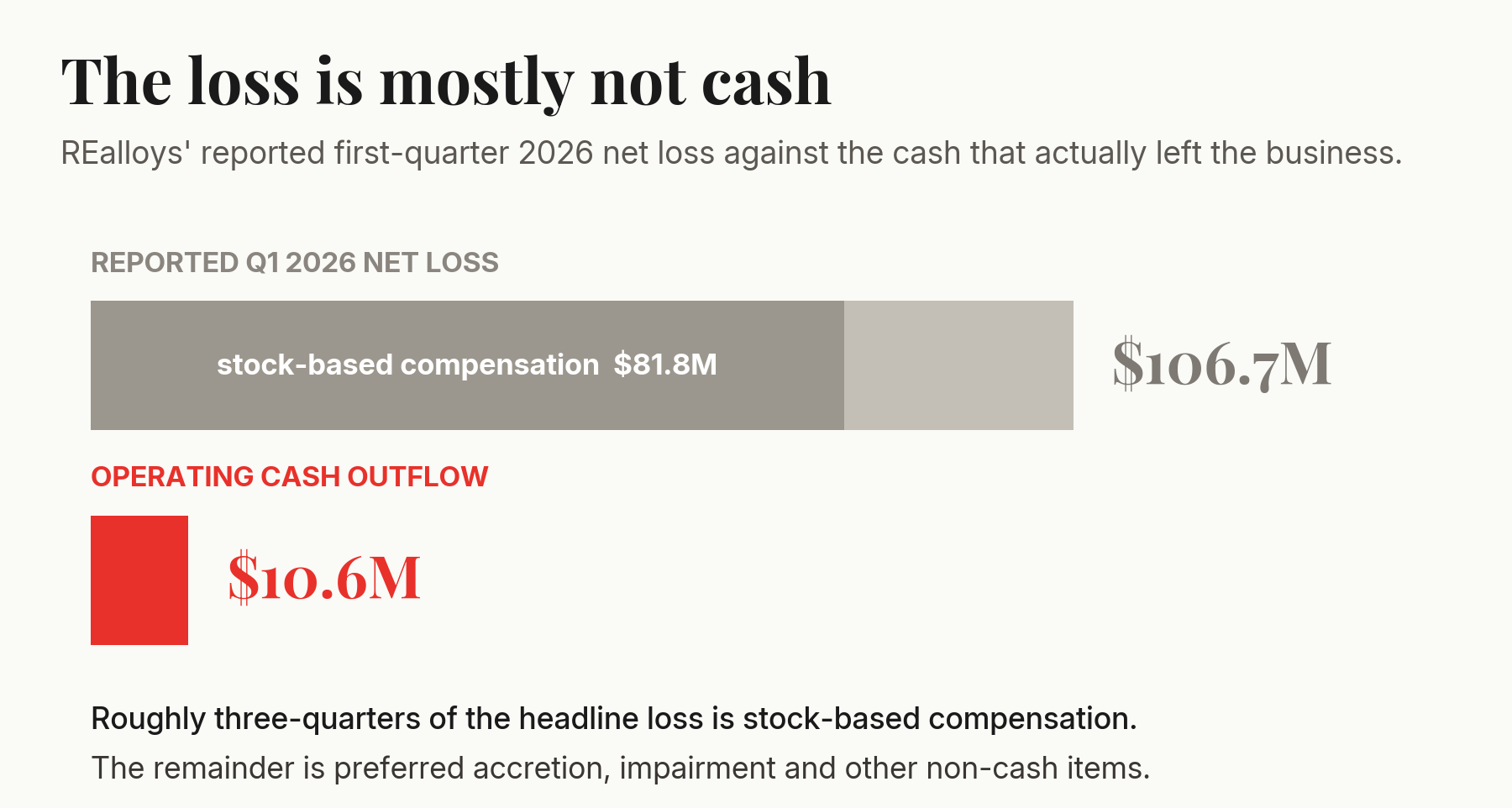
First quarter of 2026: revenue of $706,000. Loss of $106.7 million.
That’s awful economics.
That headline needs an asterisk the size of a planet. Almost all of it was accounting, not cash — $81.8 million of it was stock handed to employees and insiders, which costs the company nothing out of pocket but dilutes existing shareholders. Strip out the non-cash items and the business actually burned about $10.6 million of real money in the quarter.
But even being generous, this is a company with almost no sales. There is no revenue yet from magnets or rare earth minerals. That $706,000 is largely leftover income from Blackboxstocks — a small trading-software company REalloys merged into in February purely to get a Nasdaq listing without going through a traditional IPO.
That’s the honest starting line. A brick building, a mineral deposit, a stack of agreements, and essentially no sales.
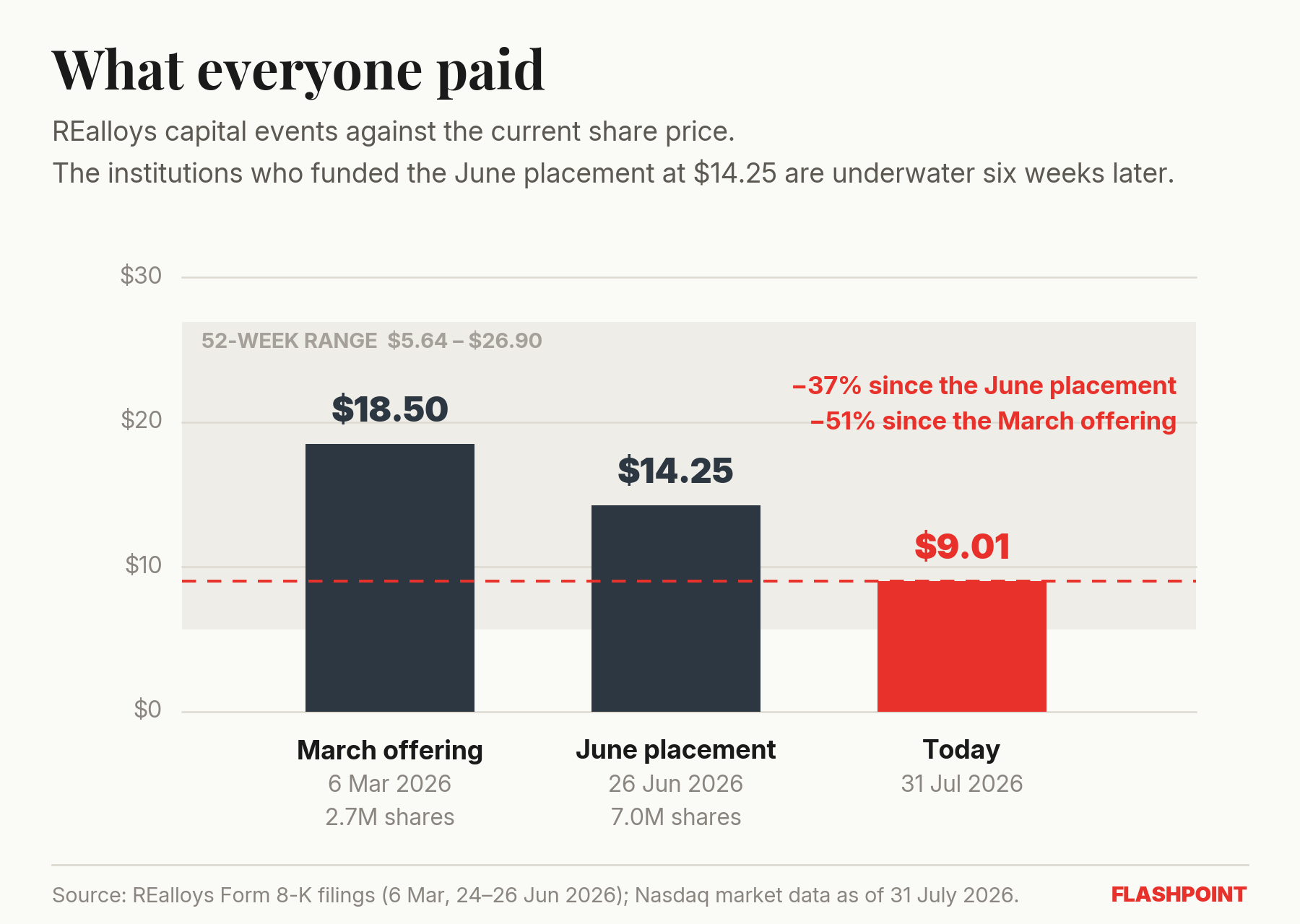
In March, it sold shares to the public at a price of $18.50, raising about $47 million. In June, it sold shares privately to institutions at $14.25, raising about $100 million.
That’s enough to build out Euclid, do the Tooele design work, and expand the Saskatchewan plant at the same time, without immediately going back to investors.
It is not enough to actually construct the Tooele site or build a magnet factory, however.
So the risk of capital dilution is strong.
Today, REalloys’ shares trade around $9. The whole company is worth about $620 million.
And the institutions who bought in at $14.25 six weeks ago are down roughly 37%.
Large price drops in speculative, high-risk companies are part of the game; and investing in REalloys doesn’t come without the downside.
Two Wall Street firms cover the stock. Clear Street says buy, with a target of $35. Needham says buy, at $19. Needham’s more conservative target implies 92% upside, whereas Clear Street's target implies a whopping 253% upside.
But weigh those accordingly: both firms were paid to sell the company’s shares in those offerings. They are not neutral observers, and there is nobody else covering the name.
The loftier Clear Street case is worth walking through anyway, because it’s the clearest version of the bull argument that exists:
Estimated 2030 EBITDA: $265 million
Valued at 11 times that figure
Assuming the company issues roughly 25% more shares along the way to fund construction (a ballpark estimate)
Implying REalloys ends up with about 7% of the global market by 2030
The value doesn’t depend on rare earth prices going up. It depends on whether tonnes get certified and delivered, and whether a chain built out of other people’s assets holds together.
That’s a question about management, not about commodity markets. Unusual for this industry — and if you’d rather bet on people than on prices, more knowable.
It’s harder to analyze the quality of management and the trajectory of an early-stage company than future changes in commodity markets. So expect re-ratings, price swings, and more.
The lopsidedness comes from the starting point. A company doing $706,000 a quarter, valued at $620 million, is priced almost entirely on a system that doesn’t exist yet.
$706,000 a quarter is pocket change for a public company. Let’s be real.
If it gets built, the shares get re-valued as a real industrial business. If it doesn’t, well, nothing happens and the stock loses all weight behind it. There isn’t much middle ground.
6. Investing In REalloys
For fifteen years the West looked at rare earths and saw a mining problem, because mining is what the photographs and presentations showed. So it funded mines. And it kept shipping powder to China, because the step in the middle — the ugly and dangerous step — was somebody else’s business.
That arrangement now has an expiry date. It’s written into a federal purchasing rule, and it takes effect January 1, 2027.
REalloys assembled a supply chain out of other people’s assets rather than paying to build its own. It convinced the Army to hand it land inside a live military base. And it has five months to turn a very good position into an approved one.
It isn’t profitable and it barely has sales. It reached the stock market through a side door five months ago. Its most exciting agreements are unsigned, only promises. Its only two analysts were paid to sell its stock.
And it is the only publicly traded company in North America standing exactly where it needs to be in the rare earths market.
Whether that brick building outside Cleveland is making metal in 2027 is the entire investment.
3 August 2026 | Deacon Brantley | Not financial advice, please take care when investing and do your own research.
If this is what the free Thursday piece looks like, consider what paid looks like: Macro deep dives, Saturday Ignition Portfolio updates with every trade and the reasoning behind it, and full access to the archives.
I had no idea how much of the rare earth supply chain depends on that middle step. Really interesting read.