
Who's Afraid Of Open Source?
The future of AI isn't behind a paywall anymore.

There’s a Beijing-based research lab called Moonshot AI, and most Americans have never heard of it.
Its researchers have spent years and hundreds of millions of dollars training a model called Kimi K3. On the benchmarks that matter, it’s nearly as good as the very best models American frontier labs offer — it’s on the level of Fable and GPT-5.6.
Oh, and it’s free.
And Moonshot AI had two options. Option one was the American playbook: lock it behind an API, charge by the token, and ride it to a multi-hundred-billion dollar valuation, a flashy IPO, and immense corporate success.
Or, there’s option two. Make it public, free to use, downloadable, and let anyone in the world use it however they want.
They chose option two.
Demand hit so hard that Moonshot had to stop letting new users sign up. And within days — this is the part I can’t get over — Washington is debating whether American companies and consumers should be banned from ever using it.

Sit with that, because at least for me, this doesn’t feel right. A lab gave away the most powerful kind of software on Earth. And the response from the richest companies in America wasn’t to compete with it. It was to call their lawyers, and then their lobbyists, crying to the regulators the entire time.
This is a story about why that happened. It’s also a story about the most important economic question of the next decade, which sounds boring until you realize everything hangs on it:
What happens when intelligence becomes a commodity?
1. What Is Open Source?
Let’s start with what open-source models actually are, because the industry has done a spectacular job making this as confusing as possible.
Strip away the mystique and an AI model is just a file. A very large file full of numbers — the “weights” — that encode everything the model learned during training. When you use ChatGPT or Claude, you never see the file. You send off your question (input tokens) to their servers, where the models interpret your question in relationship to their weights and process, and they send you back an answer (output tokens).
An open-source model is the same thing, except somebody handed you the file.
Download it. Run it on your own machine. Modify it, fine-tune it, build a business on it. Nobody can raise the price on you, because there is no price. Nobody can shut it off, because it’s yours. Instead of renting Anthropic or OpenAI’s intelligence, you have your own.
Think about what happens when a drug goes generic.
A pharmaceutical company invents a medicine and files a patent, a government-issued monopoly for about twenty years.
During those years, the company can charge whatever the market will accept, and it does. Pfizer’s cholesterol drug, Lipitor, was at its peak bringing in more than $12 billion a year.
Then, in 2011, the patent died. Suddenly it was legal for anyone to make the exact same drug. Rival factories switched on, pharmacies stocked the copies, and the price of brand-name Lipitor fell more than 90 percent.
Even today, it’s still the same molecule, with the same effect on your arteries, all for a tenth of the price.
Pfizer hated it.
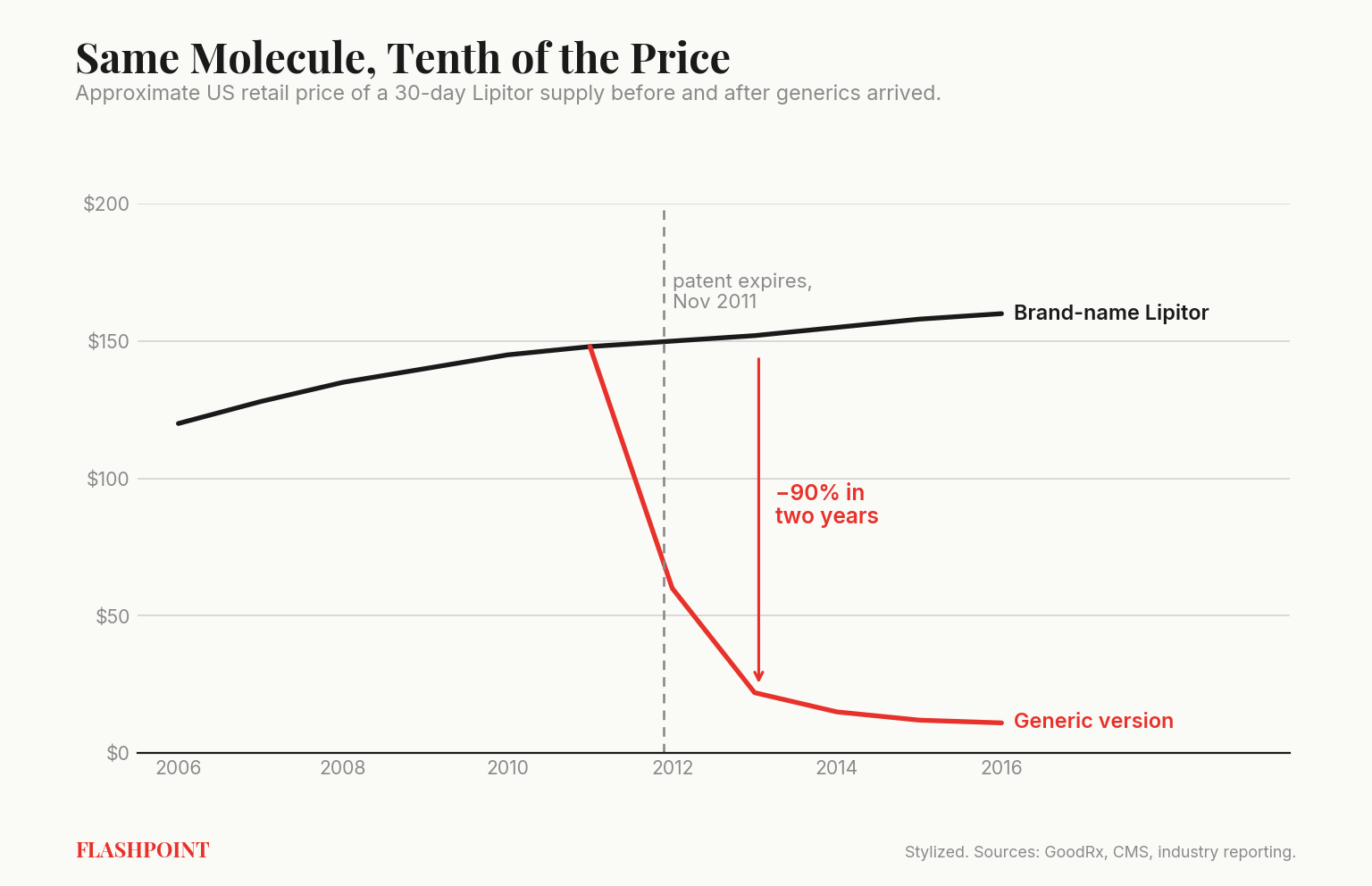
Open-source AI is generic intelligence. Similar quality for a fraction of the price. There’s just one difference, and it’s the one making the American labs furious: nobody waited for the patent to expire. The frontier labs thought they had a monopoly on intelligence, a patent-like supremacy where the only competition was with each other, but no. Open-source models are closing the gap to frontier models as I write this, with Kimi K3 being the first to actually have done so.
So who’s giving away hundred-million-dollar files? Meta, with its Llama family, was the earliest in the West. But the center of gravity has shifted decisively to China: DeepSeek out of Hangzhou, Alibaba’s Qwen, Z.ai’s GLM, and now Moonshot’s Kimi.
Which brings us to why any of this matters to you, even if you’ve never run a model in your life.
2. Economics 101
This is the famous supply & demand chart. Supply slopes up, demand slopes down, and price lives where they cross. Every intro econ student learns it.
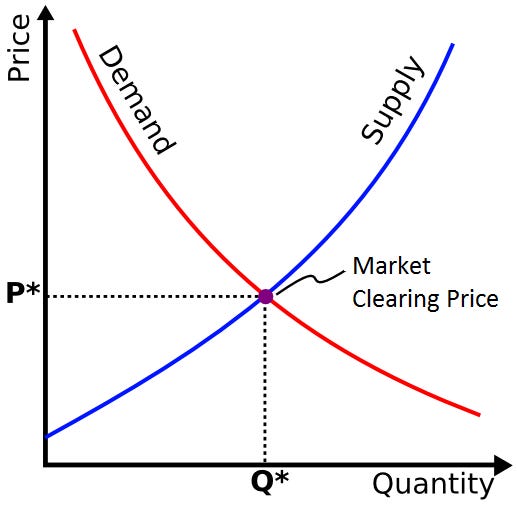
Every intro econ student also learns what happens when supply is controlled by two or three firms: the curves stop mattering, and price becomes whatever the sellers agree it should be.
In a concentrated market, everyone simply learns not to compete too hard on price. Economists call it tacit coordination. Politicians call it collusion.
Now look at what frontier intelligence costs.
The premium closed models run somewhere between $25 and $55 per million tokens, depending on which one you’re using. The leading open-source models cost under two dollars. For a huge share of real-world tasks, the quality gap between them has narrowed to the point that companies genuinely cannot tell the difference.
If you can get 95% of the quality for 3% of the cost, why wouldn’t you use open-source models instead of paying $20/mo for Claude Pro?
That’s the question shaking the frontier labs at their core.
And it’s not just you and I making this decision. Startups like Lovable and ElevenLabs have moved big chunks of their workloads off the frontier APIs and onto open models running on their own machines — reportedly saving 50 to 90 percent in costs while matching quality on the vast majority of tasks. Coinbase cut its AI spending roughly in half in just two months, largely by routing everyday prompts to open models. Its usage went up the whole time.
Here’s the part I want you to sit with, though, because it’s the part that gets missed.
Open-source models aren’t just an cheaper alternative to the frontier labs, however. They’re the only thing keeping Anthropic, OpenAI, SpaceXAI, Google, and the other frontier labs from pushing prices through-the-roof.
Chamath Palihapitiya made the point on last week’s All-In podcast that foundation models are getting commoditized much faster than anybody thought.
His thought experiment is the one that stuck with me: imagine an American company forced by law to pay fifty times more per token than its international competitors, who are free to use open models. Its costs rise. Its margins compress. Money that would’ve been allocated toward growth becomes allocated to paying gigantic AI spending.
In other words, American companies would spend fifty times as much for the same returns.
Multiply that across every American business that touches AI — which, today, is every American business. Growth would slow to a complete halt!
A ban on cheap intelligence isn’t a sanction on China. It’s a tax on us.
3. Distillation Is A Red Herring
Of course, that’s not how the frontier labs frame it. Their word is theft.
The specific accusation is distillation, so let’s unpack it.
Distillation is teaching by example.
You take a powerful frontier model like Opus 5 or GPT-5.6, send it millions of questions, collect its answers, and train your own smaller model on those answers and the reasoning. The student absorbs much of the teacher’s skill at a fraction of the training cost. Chinese labs have done this to American frontier models at industrial scale, often against the terms of service. The labs argue this is how China closed the gap so fast.
Notice what distillation is not, though. Nobody broke in. Nobody copied the weights — that file we talked about earlier stayed exactly where it was. What got “taken” was the answers. The outputs. Someone studied the published work of a very smart machine and learned from it. Is there really anything wrong with that?
And if you’re reading this, thinking to yourself that what Chinese labs are doing to American labs is a little bit like what the frontier American labs have done to the entire internet, you’d be correct.
American frontier labs trained on the New York Times, on Reddit, on the accumulated writing of basically everyone, and when the authors objected, the labs said: that’s not copying, that’s learning. Fair use. This month, Anthropic paid $1.5 billion — the largest copyright settlement in AI history — over the pirated books in its training data. But somehow, days later, it was describing distillation of its own outputs as intellectual property theft.
Learning from everyone else’s work is innovation. Learning from ours is a crime. That’s not a principle. That’s a pricing strategy. And it’s a compelling narrative being spun by the people who have most to lose from open-source AI.
And here’s the tell, courtesy of David Sacks on the same All-In episode: if stopping distillation were really the goal, the labs would go after it at the source. They would control the front door. They can see the query patterns — tens of millions of synthetic prompts don’t look like human traffic. They could enforce their own terms of service with KYC, rate limits, and account bans.
Instead, the ask in Washington is to ban Americans from using Chinese models. Chinese labs could still use American models!
That doesn’t stop distillation at all. It just eliminates the competition that distillation produced.
And distillation copies yesterday’s frontier, not tomorrow’s. Distilled models consistently score below their teachers on general benchmarks — you inherit the answers, not the mind that produced them. And the newest capability gains, the ones coming from reinforcement learning, are proving much harder to extract through outputs alone. You cannot distill your way to the lead. You can only distill your way to second place, cheaply.
Second place, cheaply, is a competitor. It is not a thief.
4. Libertarianism & Liberation
There’s a version of this essay that’s purely about money, where it’s going to, and where it’s fleeing from. But I’d be lying if I said the money was the whole reason I care about this.
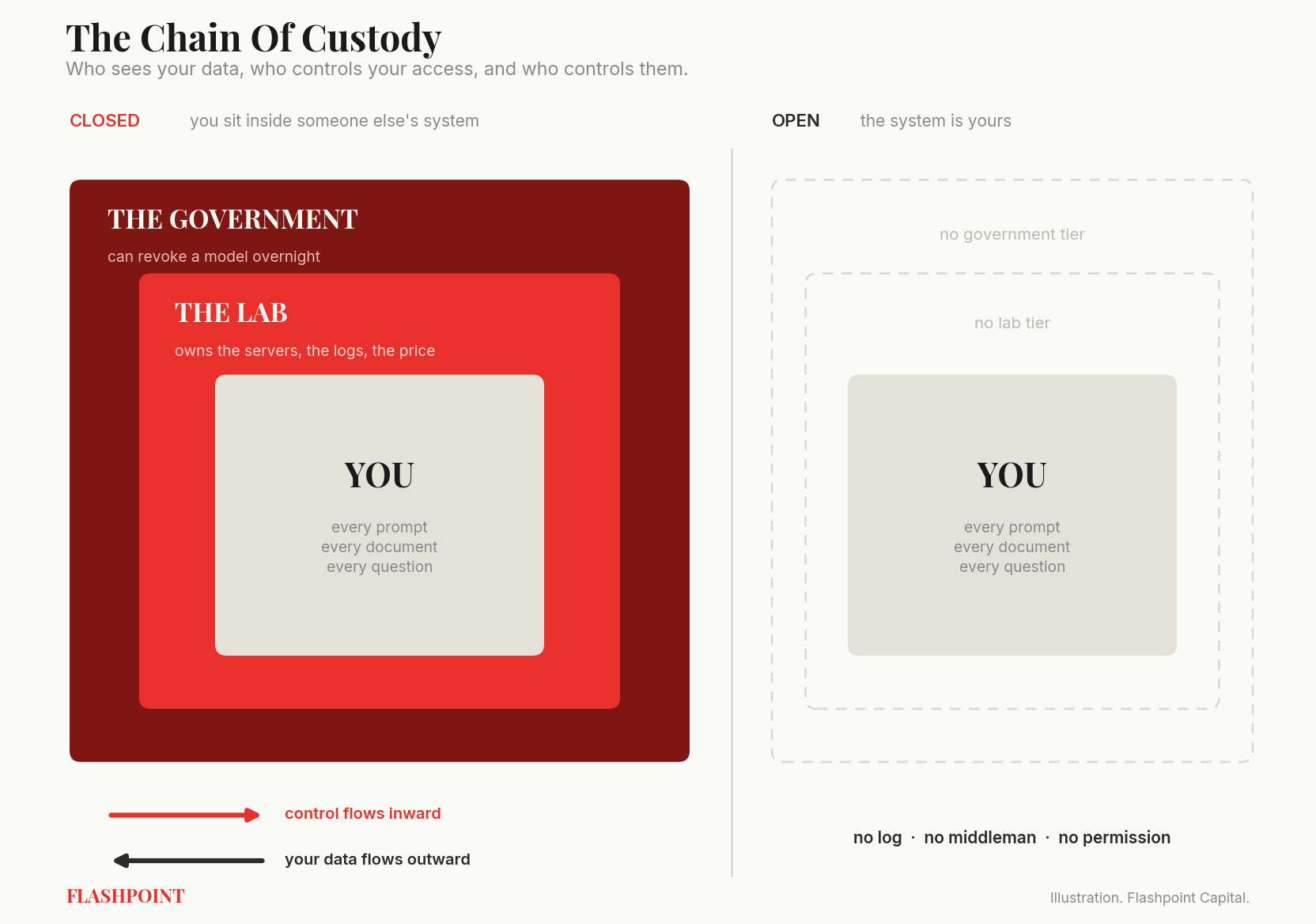
Every prompt you send in a closed model passes through someone else’s servers. It can be logged. It can be monitored. It can be subpoenaed. The model can be deprecated while your product depends on it, re-priced while your budget can’t afford it, or aligned tomorrow with values you didn’t choose.
And access can simply be revoked. This summer, our government took Fable 5 offline for nineteen days.
When intelligence lives behind an API, it exists at the whim of whoever controls the API — and whoever controls the people behind the API.
Now consider the alternative. Open-source models on your own server don’t answer to anyone. There is no log, at least none external to yourself. There is no surveillance, because there is no middleman. There is no deprecation, no price hike, no sketchy terms-of-service update. A researcher in Ohio, a startup in Lagos, a hospital that can’t legally let patient data leave the building — they all get the same privacy for cheap.
For a lesson in why you shouldn’t trust the frontier labs, just take the case of OpenAI.
You may notice the name OpenAI sounds a lot like open-source AI. And that’s because it was. Sam Altman, Elon Musk, and their cofounders originally launched the organization as a non-profit, aiming to freely share open-source AI for purely the good of humanity.
Wait, what?
But today, it’s no longer open-source, a non-profit, or creating its models solely for the benefit of humanity. It’s a corporate software company gating its models behind steep paywalls as it sees to scale as quickly as possible at the expense of the American business and consumer.
If you’d told Silicon Valley tech leaders in 2015 that OpenAI, the world’s leading research lab, would become a for-profit, corporate, closed-weight software company, they’d probably be extremely worried on what the future of AI could become.
But in an age where every keystroke is logged, every movement is tracked, and every action is recorded, open-source models give creators digital freedom they simply cannot get from the frontier labs.
5. Well…
Open-source obviously isn’t perfect, and two main questions drive the debate.
Jailbreaks are permanent, and you can’t fix them.
A closed-weight frontier lab that finds a dangerous capability or jailbreak opportunity can patch it overnight, on their servers, for everyone. An open model, once released, is out forever — every jailbreak permanent, every safeguard optional, available to any bad actors with gaming PCs. The frontier labs’ safety argument isn’t fake. When they worry about open weights and bioweapons research, or automated cyberattacks, the danger is real and worth caring about.
Chinese power drift.
The best open-source models are currently Chinese, and adopting them carries risks. Sure, you can see what’s inside the model, but you can’t see backdoors buried in weights nor other security risks, meaning adopting a Chinese open-source model could be giving the Chinese government access to your data. And a Chinese open model carries Chinese framings on Chinese questions (just ask DeepSeek if Taiwan is a country or not and see what I’m talking about).
And soft power matters too. Every American startup building on Qwen or Kimi is, in a small way, a vote for China’s world over ours.
So no, open source is not a free lunch. It’s a trade: more freedom, more competition, more proliferation, less control. I think that trade is overwhelmingly worth making. But you should know you’re making it.
6. How To Invest
The model layer is the single worst place in the AI stack to have your money.
There’s no moat. Every milestone gets matched within months. And when your pricing power erodes, you have two options: cut costs, or make competition illegal. The labs went to Washington. Companies with real moats don’t need to hire lobbyists to defend their margins.
So where’s the money?
A model is a file. Free to copy, free to send, worthless without somewhere to run. Running it takes a building full of chips, a cooling loop, and a staggering amount of electricity.
So, here’s my view.
Bullish energy. The US is short two-and-a-half to three Californias of power by 2050, before a single new data center. That gap closes with turbines, transformers, transmission, and reactors. Everything else in AI is downstream of whether the lights stay on.
Bullish neoclouds. Every prompt on Earth, whether it be open, closed, American, or Chinese, lands on somebody’s server and gets billed. They don’t care which model wins. They collect either way.
Bullish applications and physical AI. Cheap intelligence is a cost input. When the input collapses in price, the margin lands with whoever builds on top of it — and with the robots, machines, and systems that put it to work in the physical world.
Bearish the model layer. No moat, no pricing power, and a lobbying budget where a competitive advantage should be.
Thanks for reading! If this was valuable to you, consider upgrading or subscribing for more.
27 July 2026 | Deacon Brantley
Very Selected Sources (these are the most helpful ones I used)
All-In Podcast (July 2026 episodes) — the distillation debate, Sacks on enforcing at the source, Chamath on commoditization and token costs, the Lovable and ElevenLabs examples, and the US energy deficit estimate.
Interconnects and IBM’s Mixture of Experts — why distillation copies yesterday’s frontier: distilled models underperform their teachers, and RL-stage gains resist extraction.
20VC — Coinbase’s inference spending, DRAM pricing, and enterprise open-source adoption.
Primary — Moonshot AI’s Kimi K3 release; OpenAI’s 2015 founding announcement; provider pricing pages; Reuters on China weighing restrictions to overseas model access; GoodRx and CMS data on Lipitor’s post-2011 generic pricing.
Figures drawn from podcast discussion rather than filings are approximate. Charts 1 and 5 are illustrative, not data.
I liked the comparison between open source AI and generic medicine. I hope intelligence never becomes a commodity. Really interesting read, and I appreciate you taking the time to write it.
You make a very convincing case, Deacon. The trade you describe is elegant i.e. short the model layer, long the downstream application layer and the energy/input layer.
The one thing I keep coming back to, though, is Chinese distillation.
If distillation remains China’s dominant strategy, then the model layer, by definition, cannot disappear. Distillation is parasitic on frontier models. If there is nothing left at the frontier to distill, there is nothing left to compress. AI eventually becomes little more than a sophisticated commodity, perhaps a far more capable version of Microsoft Excel?
That’s why I don’t think distillation eliminates the model layer. It simply changes its economics.
It likely caps margins, not relevance.
The frontier still has to keep moving, otherwise everyone—including the distillers—stops progressing. The model companies become the R&D engine for the entire ecosystem, even if they capture a smaller share of the economic value they create.
That creates an interesting asymmetry. Capability could continue compounding exponentially while profits at the model layer grow much more linearly. That’s probably not a stable equilibrium forever. Something eventually has to change. Perhaps frontier labs merge more tightly with the application layer to capture downstream value. Perhaps proprietary data, agents, or vertically integrated products become the new moat instead of the models themselves.
Now let me offer the contra-argument.
What if China decides it no longer wants to be the world’s best distiller, but the world’s best model builder?
That changes everything.
Competition at the frontier would intensify. Training costs would likely keep falling as more companies across the U.S., China, Europe and the rest of the world race to build increasingly efficient models. Lower costs wouldn’t slow AI adoption, they would accelerate it.
History suggests that when the cost of a foundational technology collapses, demand doesn’t shrink, rather, it explodes.
In that world, everyone wins. Consumers get cheaper intelligence. Businesses build entirely new products that weren’t economically viable before. And an entirely new innovation layer emerges that we can’t yet fully see.
Ironically, the biggest long-term beneficiary of cheaper models may not be the model companies themselves, it may be the industries that become possible because intelligence became almost free…